


 中文简体
中文简体 Español
 2026.09.10
How Many Feet of Stretch Wrap Per Pallet and Which Machine Is Right for Your Output
Content
- 1 How Many Feet of Stretch Wrap Per Pallet: The Detailed Calculation
- 2 Fully-auto Pallet Stretch Wrapping Machine: How It Works and When to Specify It
- 3 Automatic Pallet Shrink Wrap Machine vs Stretch Wrap Machine: Clearing Up the Terminology
- 4 Industrial Pallet Wrapping Machine: Specifications to Evaluate for High Volume Operations
- 5 Film Consumption Reduction Strategies: Getting More Value From Every Roll
- 6 Frequently Asked Questions
- 6.1 1. How many feet of stretch wrap per pallet is considered normal?
- 6.2 2. What is the difference between a Fully-auto Pallet Stretch Wrapping Machine and a semi automatic wrapper?
- 6.3 3. Can an automatic pallet shrink wrap machine wrap pallets of different heights automatically?
- 6.4 4. How much does a Fully-auto Pallet Stretch Wrapping Machine cost?
- 6.5 5. What causes a stretch wrap machine to use too much film?
- 6.6 6. What is the wrapping cycle time of a typical industrial pallet wrapping machine?
- 6.7 7. How do I calculate the number of stretch film rolls needed per shift?
- 6.8 8. What maintenance does an industrial pallet wrapping machine require?
- 6.9 9. What film gauge is recommended for an automatic pallet shrink wrap machine?
- 6.10 10. How do I justify the capital cost of a Fully-auto Pallet Stretch Wrapping Machine versus a semi automatic alternative?
The standard stretch wrap consumption for a typical mixed goods pallet measuring 1,200 mm x 1,000 mm x 1,500 mm is 150 to 300 linear feet (46 to 91 metres) of 20-inch wide cast stretch film at 200% to 250% pre stretch, applied in 4 to 6 wrapping cycles by an automatic or industrial pallet wrapping machine. This range reflects the most common warehouse pallet configuration and standard film application programs. Unstable loads, heavier pallet weights (above 600 kg), and taller pallet profiles (above 1,800 mm) increase consumption to 300 to 500 linear feet per pallet as additional wrapping cycles and base lock wraps are added.
For machine selection: a Fully-auto Pallet Stretch Wrapping Machine is the correct specification for operations wrapping 40 or more pallets per hour continuously, where manual conveyor loading and unloading would create bottlenecks and where consistent wrap force, film overlap, and pre stretch settings must be maintained without operator variation across shifts. An automatic pallet shrink wrap machine or industrial pallet wrapping machine in the turntable or rotary arm format is appropriate for 15 to 40 pallets per hour, where semi inline operation is acceptable. Operations below 15 pallets per hour are typically better served by semi automatic turntable wrappers at significantly lower capital cost.
Quick Reference: At 200 linear feet per pallet average and a standard 5,000-foot roll of 20-inch stretch film, one roll wraps approximately 25 pallets. A facility wrapping 200 pallets per shift consumes approximately 8 rolls per shift, or 200 to 240 rolls per month on a two shift operation.
How Many Feet of Stretch Wrap Per Pallet: The Detailed Calculation
Knowing how many feet of stretch wrap per pallet your operation consumes is the foundation of stretch film procurement budgeting, machine program optimization, and load containment validation. The answer is not a single universal number but a range determined by five variables that combine to produce the actual consumption figure for any specific pallet profile and wrapping program.
Variables That Determine Stretch Wrap Consumption Per Pallet
- Pallet circumference: The perimeter of the pallet at its widest cross section is the baseline driver of film consumption. A standard 1,200 mm x 1,000 mm pallet has a circumference of approximately 4,400 mm (4.4 metres or 14.4 feet). Each complete wrap of the pallet at this circumference uses 14.4 feet of film. A wider or longer pallet increases this proportionally: a 1,200 mm x 1,200 mm square pallet has a circumference of 4,800 mm, adding 13% more film per wrap cycle versus the standard size.
- Pallet height: The number of wrapping passes from base to top is determined by the pallet height and the overlap percentage between successive film bands. At 50% overlap (the standard for stable loads) and 20-inch film width (508 mm), each pass moves the film delivery head upward by approximately 250 mm. A 1,500 mm tall pallet requires approximately 6 upward passes, each covering a 250 mm height increment. Additional roping passes (where the film is gathered to a narrow rope width for maximum containment force at the load base) add further consumption.
- Number of wrapping cycles: Most wrapping programs specify 1 to 3 complete bottom to top to bottom wrapping cycles. A single cycle for a stable load on a full auto pallet stretch wrapping machine at 200% pre stretch typically uses 150 to 200 feet of film. Two cycles use 280 to 380 feet. Three cycles for heavy or unstable loads use 400 to 600 feet. The single biggest driver of film overuse is a wrapping program set to an excessive number of cycles without a containment force validation confirming the additional cycles are necessary for load stability.
- Pre stretch percentage: Pre stretch is the degree to which the film is mechanically elongated before application to the pallet. At 200% pre stretch, 1 foot of film from the roll is stretched to 3 feet of film on the pallet. At 250% pre stretch, 1 foot becomes 3.5 feet. Higher pre stretch means more pallet coverage per roll foot consumed, directly reducing the number of roll feet used per pallet. An industrial pallet wrapping machine with a powered pre stretch carriage at 250% pre stretch uses approximately 15% to 20% fewer roll feet per pallet than an equivalent machine at 200% pre stretch on the same wrapping program, representing a proportional saving in film cost per pallet.
- Film width and gauge: Standard automatic pallet shrink wrap machine and industrial pallet wrapping machine systems use 20-inch (508 mm) wide film in gauges of 17 to 23 microns for pre stretched application. Thicker film (23 microns at 200% pre stretch) provides more puncture resistance for sharp edged loads; thinner film (17 microns at 250% pre stretch) reduces material cost per pallet but requires the machine's pre stretch system to be well calibrated and maintained to avoid film breaks at higher elongation ratios.
Stretch Wrap Consumption Reference Table by Load Type
| Load Profile | Pallet Dimensions (mm) | Wrapping Cycles | Film Feet at 200% Pre stretch | Film Feet at 250% Pre stretch | Rolls per 200 Pallets |
|---|---|---|---|---|---|
| Stable uniform goods | 1200 x 1000 x 1200 | 1 | 150 to 180 | 115 to 140 | 6 to 8 |
| Standard mixed goods | 1200 x 1000 x 1500 | 2 | 200 to 280 | 155 to 215 | 8 to 12 |
| Heavy or dense loads | 1200 x 1000 x 1400 | 2 | 220 to 300 | 170 to 230 | 9 to 13 |
| Unstable or irregular loads | 1200 x 1000 x 1600 | 3 | 350 to 500 | 270 to 385 | 14 to 20 |
| Tall pallet (double stacked) | 1200 x 1000 x 2100 | 2 | 300 to 420 | 230 to 320 | 12 to 17 |
Containment Force: The Correct Standard for Evaluating Stretch Wrap Program Adequacy
Counting how many feet of stretch wrap per pallet are applied is an input measurement, not a quality outcome measurement. The correct performance standard for any wrapping program on a Fully-auto Pallet Stretch Wrapping Machine, automatic pallet shrink wrap machine, or industrial pallet wrapping machine is the containment force achieved at the pallet mid height, measured in Newtons or pounds force using a standardised containment force meter.
The ASTM D4169 and EUMOS 40509 standards for pallet load containment specify minimum containment force targets by load weight and transport mode:
- Road transport (standard): Minimum 150 Newtons (33 pounds force) containment force measured at pallet mid height on all four faces
- Road transport (challenging routes or long distances): 200 to 300 Newtons (45 to 67 pounds force)
- Air freight (vibration intensive): 300 to 400 Newtons (67 to 90 pounds force)
- Sea freight (long duration, multi modal): 400 Newtons or above (90 pounds force or above)
Operations that validate wrapping programs against containment force targets (rather than simply counting film applications or following arbitrary wrapping program settings) consistently achieve film consumption reductions of 15% to 30% by identifying programs that were applying more film than necessary and reducing cycles accordingly, without compromising load integrity or transit damage rates.
Fully-auto Pallet Stretch Wrapping Machine: How It Works and When to Specify It
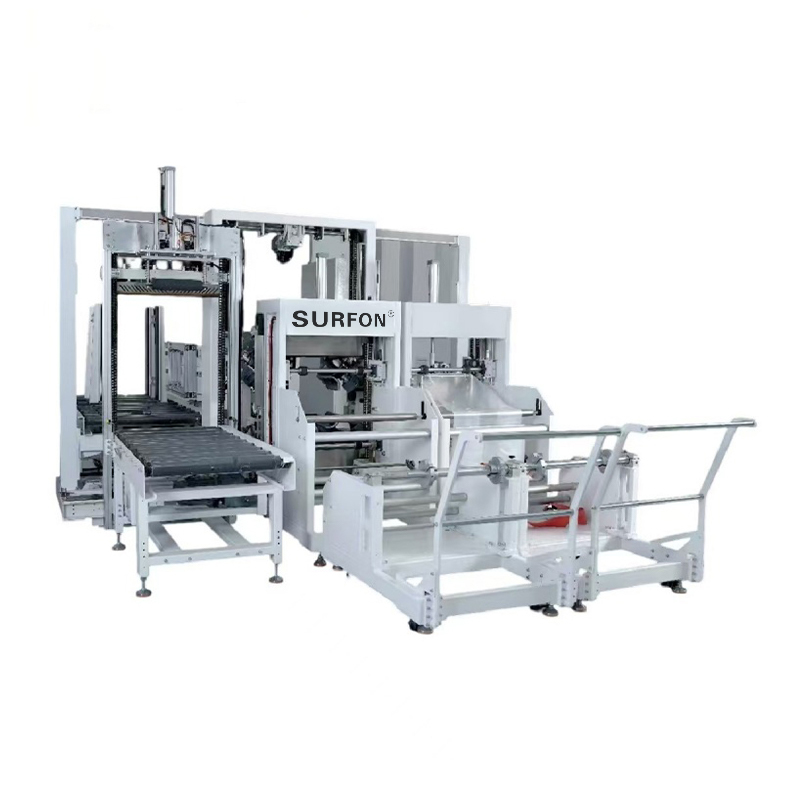
A Fully-auto Pallet Stretch Wrapping Machine is an inline automated system that loads, wraps, and discharges pallets without any operator involvement in the loading or unloading process. The pallet enters the machine on an infeed conveyor (typically from the end of a production or packaging line), the machine detects the pallet presence through photoelectric sensors, applies the programmed wrapping cycle automatically, cuts and wipes or welds the film tail at the end of the cycle, and discharges the wrapped pallet onto an outfeed conveyor for automatic label application, checkweighing, or sortation downstream. The entire cycle from pallet entry to discharge takes 60 to 120 seconds depending on the machine model, pallet height, and wrapping program.
Three Mechanical Formats of the Fully-auto Pallet Stretch Wrapping Machine
- Fully automatic turntable wrapper: The pallet sits on a rotating turntable platform that spins at 6 to 20 rotations per minute while a vertical film delivery carriage travels up and down the mast alongside the rotating pallet. This is the most common format for production facilities with 20 to 60 pallets per hour throughput requirements and pallet weights up to 2,000 kg. The turntable format has a moderate footprint (typically 2,500 mm x 2,500 mm for the wrapping zone plus infeed and outfeed conveyor runs) and achieves consistent wrap quality at the lowest capital cost among fully automated formats. The limitation is that very heavy pallets (above 2,000 kg) or unstable loads where rotation could cause product shift cannot be processed on a turntable without load securing prior to wrapping.
- Fully automatic rotary arm wrapper: The pallet remains stationary on the infeed conveyor while a rotating arm carrying the film carriage orbits the pallet, applying film to all four sides through the arm's rotation rather than the pallet's rotation. The rotary arm format is the preferred configuration for very heavy pallets (above 2,000 kg), unstable or irregularly shaped loads that cannot be rotated without product collapse risk, and operations where the infeed and outfeed conveyor runs must be perfectly aligned without the turntable's rotating platform interrupting the straight conveyor line. Rotary arm machines have a larger footprint than equivalent turntable machines and higher capital cost (typically 30% to 50% more at equivalent throughput capacity) but handle a wider range of load types without special pre treatment.
- Fully automatic orbital (horizontal) wrapper: Used for loads that cannot be loaded onto a turntable or rotary arm machine at all, including very long loads (pipes, lumber, extrusions), horizontal cylinders (coils, rolls, drums), and loads on special low profile pallets. The pallet or load passes horizontally through a rotating ring that applies film in a spiral pattern perpendicular to the direction of travel. This format is specialised and less common than turntable and rotary arm configurations in general warehouse and distribution applications.
Fully-auto Pallet Stretch Wrapping Machine Throughput and Integration Requirements
Integrating a Fully-auto Pallet Stretch Wrapping Machine into a production or distribution line requires careful throughput capacity matching to avoid creating a bottleneck at the wrapping station:
- Machine cycle time versus line output rate: If the production line outputs a finished pallet every 90 seconds, the fully automatic wrapper must complete its cycle (including film cut and wipe, pallet discharge, and next pallet acceptance) in 90 seconds or less. A machine rated for 60-second cycle time provides 20 pallets per hour capacity, while a 90-second cycle time machine provides 40 pallets per hour. Specifying a machine with at least 15% to 20% cycle time headroom below the line output rate prevents the wrapping station from becoming the throughput constraint when line speed increases or when complex load programs require additional wrapping cycles.
- Film roll change time: A standard 5,000-foot roll of 20-inch stretch film weighing approximately 15 to 18 kg is exhausted in 25 to 35 pallets at typical consumption rates. On a line running 40 pallets per hour, this requires a roll change every 40 to 50 minutes. A Fully-auto Pallet Stretch Wrapping Machine with automatic roll change capability (a second film carriage that pre loads the next roll and splices it to the expiring roll tail without stopping production) eliminates the operator intervention and production stop associated with manual roll changes at high throughput facilities.
- Downstream conveyor integration: The outfeed conveyor of the fully automatic wrapper must connect directly to the downstream process (label application, checkweigher, sortation system, or dock door staging). Conveyor speed, pallet orientation, and height compatibility between the wrapper's outfeed conveyor and the receiving downstream conveyor must be confirmed during machine specification and layout design to avoid transfer jams at the connection points.
- PLC communication and line management system integration: Most modern Fully-auto Pallet Stretch Wrapping Machine systems include a PLC with an Ethernet or fieldbus communication port that allows the machine to receive pallet specific wrapping program instructions from the warehouse management system (WMS) or line management system (LMS) based on the pallet's barcode or RFID identity. This capability allows different products (requiring different wrapping programs, film tensions, and cycle counts) to be processed sequentially on the same line without operator program changes between pallets.
Automatic Pallet Shrink Wrap Machine vs Stretch Wrap Machine: Clearing Up the Terminology
The term automatic pallet shrink wrap machine appears in product searches and is often used interchangeably with stretch wrap machine in the marketplace, but the two technologies are physically distinct and produce different wrap characteristics on the finished pallet. Understanding the technical difference prevents specification errors when sourcing equipment.
Stretch Wrap vs Shrink Wrap: The Physical Difference
Stretch wrap (also called stretch film or LLDPE stretch film) is applied to the pallet under mechanical tension, using the film's elastic recovery force to hold the load together. The film is stretched to 150% to 300% of its original length before or during application, and its elastic recovery from this stretched state generates the containment force that consolidates the pallet load. No heat is applied in the stretch wrapping process.
Shrink wrap is applied loosely over a load (as a bag, sleeve, or sheet) and then passed through a shrink tunnel where radiant heat causes the film to contract to the shape of the load. Shrink wrap produces an extremely tight conforming wrap that follows the exact profile of the load, including irregular shapes, but requires heat energy input and a shrink tunnel infrastructure that makes the process significantly more capital and energy intensive than stretch wrapping for standard pallet loads. In practical modern warehouse usage, almost all references to an "automatic pallet shrink wrap machine" in standard pallet wrapping contexts refer to a stretch wrap machine rather than a true heat shrink tunnel system, because heat shrink pallet wrapping is a specialised application used primarily for retail presentation or waterproofing of palletised products in specific industries (food retail, beverages) rather than general logistics and distribution.
When True Shrink Wrapping Is Used Instead of Stretch Wrapping
- Retail ready pallet presentation: Products destined for direct to shelf retail display where the pallet wrap forms part of the product's retail presentation (branded shrink film, coloured film with printed graphics) use true shrink film for the tight conforming wrap that stretch film cannot achieve on products with irregular top surfaces.
- Waterproof outdoor pallet storage: Shrink wrap applied as a full pallet cover and shrunk to a sealed envelope provides a more waterproof result than stretch film for pallets stored outdoors for extended periods. The sealed seams of shrunk film prevent rain entry from the top or sides; stretch film's overlapping wraps allow some water infiltration in sustained heavy rain.
- Product grouping for consumer packaging: Multipack groupings (beverage can packs, bottle multipacks) use heat shrink film to create the individual consumer unit before palletisation. This application is upstream of pallet wrapping and is a packaging machine function rather than a palletising machine function.
Industrial Pallet Wrapping Machine: Specifications to Evaluate for High Volume Operations
An industrial pallet wrapping machine in the context of high volume distribution, manufacturing, and cold chain logistics must meet a different set of performance and durability requirements than light commercial or semi automatic equipment. The following specifications are the critical evaluation criteria for industrial grade procurement decisions.
Pre Stretch Carriage System: The Core Performance Component
The pre stretch carriage in an industrial pallet wrapping machine is the mechanical assembly that elongates the film before it contacts the pallet, through a powered two roller system where the exit roller spins faster than the entry roller by the pre stretch ratio. The quality and adjustment range of the pre stretch carriage determines the film savings achievable and the wrapping consistency across all load types:
- Adjustable pre stretch range: A quality industrial pallet wrapping machine carriage should provide continuously adjustable pre stretch from 0% (no elongation, for specialised loads requiring lower tension) to at least 250% (for maximum film economy on standard loads). Fixed pre stretch carriages at a single ratio (often 200%) are less flexible for operations handling varied load types requiring different film tension profiles.
- Powered versus passive pre stretch: Passive pre stretch (also called brake roller pre stretch) relies on the mechanical resistance between two rollers to elongate the film as the turntable rotation or arm rotation pulls it. Powered pre stretch uses servo or DC motors to actively drive both the entry and exit rollers at their programmed speed differential. Powered pre stretch maintains the specified elongation ratio consistently regardless of the pallet's rotational speed or the film's pull resistance, producing consistent wrap quality across the full wrapping cycle. Passive systems lose pre stretch ratio consistency when turntable speed varies or when the film encounters varying tension from load protrusions, resulting in patchy containment force across the pallet face.
- Film tension control: Independent control of the film tension (the resistance applied to the film between the carriage and the pallet) allows the wrapping program to specify higher tension at the pallet base (where maximum containment force is most needed to prevent base layer shift during pallet movement by forklift) and lower tension at the top of the pallet (where high tension risks crushing lightweight or fragile upper layer products). A precision industrial pallet wrapping machine allows independent tension zone programming for the base, body, and top of each pallet load.
Machine Throughput and Cycle Time Performance
Throughput for an industrial pallet wrapping machine is measured in pallets per hour under continuous operation on the specific load profile and wrapping program the machine will be used with. Manufacturer stated throughput figures are typically measured on a standard stable load at the minimum wrapping program (1 cycle, low tension, standard film width), which represents the fastest achievable cycle time rather than the realistic throughput for the actual loads and programs the buyer needs:
- Request throughput specification at the buyer's actual load parameters: Before finalising equipment selection, provide the machine manufacturer with the actual pallet dimensions, weight, load stability category, and intended wrapping program (number of cycles, tension settings, roping requirements) and request a confirmed cycle time calculation at these conditions. A machine rated at "80 pallets per hour" may achieve only 45 to 55 pallets per hour at the buyer's actual 3-cycle program on tall pallets.
- Turntable speed range: Standard industrial turntable wrappers rotate at 6 to 20 RPM. Higher turntable speeds reduce cycle time but increase the risk of load instability on lighter or top heavy pallets where centrifugal force at high rotation speed can cause the top layer of the load to shift outward before the film application has stabilised it. A programmable turntable speed that starts low, accelerates to wrapping speed after the first stabilising wrap has been applied, and decelerates before stopping provides the fastest safe cycle time for a wide range of load types.
Film Cut and Wipe or Weld System: The Cycle Completion Mechanism
At the end of each wrapping cycle, the film tail must be secured to the pallet to prevent the wrap from unspooling during handling and transport. The three film tail management systems used on industrial pallet wrapping machine and Fully-auto Pallet Stretch Wrapping Machine products are:
- Cut and wipe system: A blade cuts the film and a heated or mechanically pressed wipe pad presses the film tail against the pallet side, relying on the film's self adhesion (cling) to hold the tail in place. This system is reliable for standard LLDPE stretch film but produces a less secure tail attachment on films with low cling (some specialty films or very thin gauges), and the wipe pad requires periodic replacement as it wears from film contact.
- Heat weld system: A heated bar welds the film tail to the last wrap on the pallet, creating a sealed bond that is stronger and more reliable than the adhesion only wipe system. The heat weld is the preferred system for unstable loads where vibration in transit could release a wipe only tail attachment, and for cold chain operations where reduced film cling at low temperature makes wipe only attachment unreliable.
- Tuck under system: The film tail is mechanically tucked under the last wrap layer rather than cut and welded, producing no film waste and requiring no consumable wipe pad or heating element. This system is slower than cut and wipe but produces a very secure tail attachment and eliminates the maintenance requirements of the wipe pad and heat element systems.
Machine Construction and Durability Standards for Industrial Applications
An industrial pallet wrapping machine in a 24-hour, 6-day per week distribution centre operation must be constructed to withstand continuous mechanical stress, exposure to warehouse environments (dust, temperature variation, occasional forklift contact), and the cumulative wear of wrapping 500 to 1,000 pallets per day for 10 or more years. Construction quality indicators:
- Frame construction: Welded structural steel frame with minimum 6 mm wall thickness on structural members, powder coated or hot dipped galvanised for corrosion resistance in humid or cold chain environments. Extruded aluminum or sheet metal frame machines are adequate for light commercial use but insufficient for 24-hour industrial operations where frame fatigue from continuous vibration accumulates over years of service.
- Drive systems: Servo motor drives with absolute encoder feedback on the film carriage vertical travel, turntable rotation, and pre stretch rollers provide the positional accuracy and repeatability needed for consistent wrap quality across all load types. Frequency drive AC motor systems are adequate for standard operations at lower cost; servo systems provide the highest repeatability for precision wrapping programs and the fastest response to load specific speed adjustments.
- Electrical protection rating: For cold store or frozen goods applications, the machine's electrical cabinet and motor junction boxes must meet IP54 or IP65 ingress protection ratings to prevent condensation related short circuits when the machine is moved between cold store and ambient temperature zones during maintenance or when warm humid ambient air enters the cold store and condenses on cold machine surfaces.
- Safety systems: Compliant safety guarding (CE marked in Europe, UL listed in North America) with emergency stop circuits, safety light curtains at the infeed and outfeed conveyor openings, and turntable rotation guards that prevent operator access to the rotating platform during machine operation are mandatory specifications for any industrial facility subject to workplace health and safety inspections.
Film Consumption Reduction Strategies: Getting More Value From Every Roll
For operations using a Fully-auto Pallet Stretch Wrapping Machine or industrial pallet wrapping machine, the film cost is typically the largest ongoing operating expense of the wrapping system, exceeding machine maintenance, electricity, and operator labor combined in high throughput facilities. Three systematic approaches to reducing film consumption without compromising load containment deliver the highest return on the investment of engineering time required to implement them.
Strategy 1: Pre Stretch Optimisation
Increasing the machine's pre stretch ratio from 200% to 250% reduces film consumption by approximately 16% while maintaining the same containment force on the wrapped pallet, because the same metre of film from the roll is stretched to cover 16% more pallet surface area at the higher ratio. The constraint is film gauge: at 250% pre stretch, 17-micron film approaches its elongation limit and may experience breaks on loads with protruding corners or edges that concentrate stress on a narrow film cross section. A practical implementation approach is to trial the higher pre stretch on the most stable load type first, validate containment force results against the target specification, and expand to other load types progressively based on zero break performance over a defined trial period of at least 1,000 pallets before committing to the higher ratio as the standard program setting.
Strategy 2: Wrapping Program Audit and Optimisation
Many operations accumulate wrapping programs that were set conservatively when the machine was first commissioned and were never subsequently reviewed. A wrapping program audit involves measuring containment force on a representative sample of 20 to 30 pallets from each program in the machine's library, comparing the measured force to the target specification for the load type, and reducing wrapping cycles on programs where measured containment force exceeds the target by more than 30%. A 30% excess over target specification typically indicates that the program can be reduced by half a wrapping cycle without falling below the containment force minimum for that load type. Operations that conduct a full wrapping program audit typically find that 40% to 60% of their programs are set to excessive film application, and achieve average film consumption reductions of 20% to 35% from the audit process alone, without any capital investment in new equipment or film grades.
Strategy 3: Film Grade Specification Review
Many facilities use the same stretch film for all pallet types despite significant variation in the load weights, sizes, and containment requirements across their product range. A tiered film specification approach assigns different film gauges to different load categories: heavier or sharper edged loads use 23-micron film at 200% pre stretch for puncture resistance, while lighter and regular shaped loads use 17-micron film at 250% pre stretch for maximum economy. The film cost per pallet for the lighter load tier decreases by 20% to 30% compared to using 23-micron film universally. The implementation requires the Fully-auto Pallet Stretch Wrapping Machine or automatic pallet shrink wrap machine to have multiple film carriage capability (where two carriages loaded with different film grades can be switched between based on the pallet identity received from the WMS) or to be configured for rapid manual film change between load types.
Frequently Asked Questions
1. How many feet of stretch wrap per pallet is considered normal?
Normal stretch wrap consumption is 150 to 300 linear feet per pallet for a standard mixed goods pallet measuring 1,200 mm x 1,000 mm x 1,500 mm, wrapped in two cycles at 200% pre stretch on an industrial pallet wrapping machine. Lighter stable loads in a single wrapping cycle use 130 to 180 feet. Heavy or unstable loads in three cycles use 350 to 500 feet. Operations consuming more than 400 feet per pallet on standard loads should audit their wrapping programs, as this level of consumption almost always indicates excessive cycle counts, unnecessary roping passes, or a pre stretch setting below 200% that is consuming more roll footage than the load's containment force requirement justifies.
2. What is the difference between a Fully-auto Pallet Stretch Wrapping Machine and a semi automatic wrapper?
A Fully-auto Pallet Stretch Wrapping Machine loads, wraps, and discharges pallets through automated conveyor systems without any operator involvement in the cycle after the machine is running. A semi automatic wrapper requires an operator to manually position the pallet on the turntable, attach the film to the pallet, start the wrapping cycle by pressing a button or foot pedal, and manually cut the film at the end of the cycle. Semi automatic machines are appropriate for 5 to 20 pallets per hour where the labor cost of manual loading and unloading is acceptable. Fully automatic machines justify their higher capital cost (typically 2 to 4 times the cost of a semi automatic equivalent) at throughputs above 30 to 40 pallets per hour where the saved operator labor cost amortises the capital premium within 18 to 36 months of operation.
3. Can an automatic pallet shrink wrap machine wrap pallets of different heights automatically?
Yes, modern automatic pallet shrink wrap machine and industrial pallet wrapping machine systems include height sensing (through ultrasonic or photoelectric sensors positioned at the machine entry) that detects each pallet's actual height as it enters the machine and automatically selects the appropriate wrapping program from the machine's library for that height category. More advanced systems use data from the WMS (received via barcode scan or RFID read at the machine entry conveyor) to select the exact program for that specific pallet's product type and load profile, regardless of height, providing load type specific tension and cycle count without operator program selection between pallets.
4. How much does a Fully-auto Pallet Stretch Wrapping Machine cost?
A Fully-auto Pallet Stretch Wrapping Machine in a standard turntable configuration with infeed and outfeed conveyors costs USD 35,000 to USD 80,000 depending on throughput capacity, pre stretch carriage type, film tail management system, and PLC communication specification. Rotary arm fully automatic machines cost USD 50,000 to USD 150,000. Premium configurations with automatic film roll change, servo drive systems, and full WMS integration sit at the top of each range. Installation (electrical connection, conveyor integration, commissioning) typically adds 10% to 20% of the equipment cost. Operating costs include stretch film (the largest ongoing cost), maintenance parts (typically USD 3,000 to USD 8,000 per year for a well maintained machine), and electricity (a turntable industrial pallet wrapping machine typically draws 3 to 8 kW during operation).
5. What causes a stretch wrap machine to use too much film?
The five most common causes of excessive stretch film consumption on an industrial pallet wrapping machine or Fully-auto Pallet Stretch Wrapping Machine are: wrapping programs set to excessive cycle counts that were not reviewed after initial commissioning; pre stretch ratios set below 200% without justification from a load specific containment force test; operator manual wrapping additions to automatically wrapped pallets due to perceived inadequacy of the machine program; film breaks causing partial cycles to be repeated; and film waste from frequent roll changes due to running rolls to nearly empty before changing. A structured film audit addressing each of these causes can reduce consumption by 20% to 40% in most operations without any capital investment or load integrity compromise.
6. What is the wrapping cycle time of a typical industrial pallet wrapping machine?
The wrapping cycle time of a typical industrial pallet wrapping machine in turntable format ranges from 45 seconds to 120 seconds per pallet, corresponding to 30 to 80 pallets per hour throughput capacity. The cycle time is determined by the turntable speed, the number of wrapping cycles in the program, the pallet height (which determines how many vertical carriage passes are required), and the film cut and wipe or weld time at the end of the cycle. A standard 2-cycle program on a 1,500 mm tall pallet at 10 RPM turntable speed takes approximately 70 to 90 seconds per pallet on most industrial turntable machines, equating to 40 to 51 pallets per hour. Rotary arm machines have slightly longer cycle times for equivalent load profiles because the arm rotation is slower than turntable rotation, but the trade off is the ability to handle pallet weights and load instability levels that turntable machines cannot safely accommodate.
7. How do I calculate the number of stretch film rolls needed per shift?
Calculate rolls per shift by: (pallets per shift x average feet of stretch wrap per pallet) divided by feet per roll. For 200 pallets per shift at 220 feet per pallet average consumption on a standard 5,000-foot roll: (200 x 220) / 5,000 = 44,000 / 5,000 = 8.8 rolls per shift. Round up to 9 rolls per shift to ensure no production stop at end of shift from roll exhaustion. A safety stock of 15% to 20% above this calculated quantity (10 to 11 rolls in this example) is the standard practice to buffer against consumption variation from different load types processed during the shift and to cover film waste from breaks or program overrides. For a full month on two shifts, this facility would require approximately 9 rolls per shift x 2 shifts x 22 working days = 396 rolls per month, which is the correct basis for monthly procurement quantity calculation and roll storage space planning.
8. What maintenance does an industrial pallet wrapping machine require?
An industrial pallet wrapping machine requires the following routine maintenance on the intervals specified: daily (operator performed) inspection of film carriage rollers for film build up, cleaning of the cut and wipe pad or weld bar, and checking of the film tension brake setting against the program specification; weekly lubrication of the turntable bearing and vertical carriage guide rails per the manufacturer's lubrication schedule; monthly inspection of the safety light curtains and emergency stop function by triggering each during a test cycle and confirming machine stop response; and 6-month or annual preventive maintenance by a service technician covering all drive system components, pre stretch roller condition and alignment, electrical connection inspection, and PLC firmware and program backup. Total annual maintenance cost for a well maintained industrial turntable wrapping machine is approximately USD 3,000 to USD 6,000 in parts and service labor, excluding unplanned breakdown repair.
9. What film gauge is recommended for an automatic pallet shrink wrap machine?
The recommended film gauge for an automatic pallet shrink wrap machine or industrial pallet wrapping machine is 17 to 23 microns for the most common applications. Specifically: 17-micron film at 250% pre stretch is the most economical specification for stable uniform loads with no sharp edges, producing the highest film yield (coverage per roll) and the lowest film cost per pallet. 20-micron film at 200% to 225% pre stretch is the standard specification for mixed loads with moderate corner sharpness and load weight variation, balancing economy and puncture resistance. 23-micron film at 200% pre stretch is appropriate for heavy loads (above 800 kg), loads with sharp edged products (metal components, boxed equipment with exposed corners), and any load where film breaks have been a recurring problem at lower gauges. Gauge selection should always be validated against actual film break rate in production (a break rate above 1 per 200 pallets indicates the gauge is insufficient for the load type or the pre stretch ratio is too high for the film grade being used).
10. How do I justify the capital cost of a Fully-auto Pallet Stretch Wrapping Machine versus a semi automatic alternative?
The capital cost of a Fully-auto Pallet Stretch Wrapping Machine versus a semi automatic alternative is justified through four value streams that should be quantified in a formal return on investment calculation: (1) Direct labor saving from eliminating the wrapping operator position (a dedicated wrapping operator costs USD 35,000 to USD 55,000 per year including employer costs in most developed markets; a fully automatic machine pays back its capital premium over a semi automatic in 1 to 3 years from this saving alone at 30 or more pallets per hour); (2) Film consumption reduction from consistent pre stretch and tension application without operator variation, typically saving 10% to 20% of film cost versus semi automatic operation on the same load types; (3) Reduced product damage from consistent containment force application that eliminates the under wrapping that occurs when a tired or distracted operator reduces wrap cycles from the program specification; and (4) Throughput capacity increase that eliminates the wrapping station as a production bottleneck, allowing the upstream line to run at its maximum output rate without waiting for manual wrapping completion before the next pallet can be loaded for wrapping.



Copyright @ Shanghai KUKO Packing Machinery Co., Ltd. All rights reserved
