


 中文简体
中文简体 Español
 2026.09.16
How Much Stretch Wrap Per Pallet? Calculate Film Usage and Reduce Costs
Content
- 1 Why the Number Varies: Key Factors That Determine Per-Pallet Film Consumption
- 2 How to Calculate Stretch Wrap Usage Per Pallet: A Step-by-Step Formula
- 3 Hand Wrapping vs. Machine Wrapping: Coverage and Cost Comparison
- 4 Choosing the Right Equipment to Optimize Stretch Wrap Usage
- 5 Practical Tips to Reduce Stretch Wrap Consumption Per Pallet
- 6 Conclusion: Know Your Numbers, Cut Your Costs
If you are wrapping a standard 48×40-inch pallet to a height of 60 inches with hand stretch wrap at 100% pre-stretch, expect to use 150–200 feet of film per pallet. That figure drops to 50–70 feet per pallet when using a quality machine wrapper with a 250% stretch rate. The difference is not just in labor—it directly impacts your annual film spend.
Why the Number Varies: Key Factors That Determine Per-Pallet Film Consumption
Every warehouse and production line has unique pallet dimensions, load types, and wrapping specifications. Understanding these variables is the first step toward accurate calculation and cost control.
Pallet Dimensions and Perimeter
The film required per revolution equals the perimeter of the pallet plus an overlap for secure wrapping. A standard 48×40-inch pallet has a perimeter of (48+40)×2 = 176 inches, or 14.67 feet. Larger pallets or those with irregular shapes increase this baseline. For example, a 48×48-inch pallet has a perimeter of 192 inches (16 feet), adding roughly 9% more film per revolution.
Number of Revolutions (Layers)
Typical hand wrapping uses 3–5 revolutions at the top and bottom, and 2–3 in the middle, totaling around 8–12 revolutions for a stable load. Machine wrapping often uses fewer total revolutions because the film is tensioned uniformly. Light loads under 2,000 lbs may require only 6–8 machine revolutions, while heavy or unstable loads can need 12–15.
Stretch Rate (Pre-Stretch)
Stretch rate is the multiplier that directly reduces film consumption. Hand wrapping typically achieves 50–100% stretch (i.e., 1 foot of film stretches to 1.5–2 feet). Machine wrappers with powered pre-stretch can reach 200–300%, meaning you use much less raw film per pallet. A machine running at 250% stretch uses 2.5 feet of usable wrap for every 1 foot of film drawn from the roll.
Overlap and Film Gauge
Industry standards recommend 50–70% overlap between successive wraps to maintain load integrity. Thicker film (e.g., 80 gauge vs. 60 gauge) provides more puncture resistance but uses more material per foot. However, thicker film can sometimes reduce the number of required layers, creating a trade-off.
How to Calculate Stretch Wrap Usage Per Pallet: A Step-by-Step Formula
Use this formula to estimate film consumption for any pallet-load configuration:
Film Used per Pallet (ft) = [Pallet Perimeter (ft) × Number of Revolutions] ÷ Stretch Rate (as decimal)
For machine wrapping, multiply revolutions by an overlap factor of 1.5–2.0 if needed. Below is a worked example.
| Variable | Hand Wrap | Machine Wrap |
|---|---|---|
| Pallet Perimeter | 14.67 ft | 14.67 ft |
| Revolutions per Pallet | 10 | 8 |
| Stretch Rate | 100% (1.0) | 250% (2.5) |
| Film Used (feet) | 146.7 ft | 46.9 ft |
Even with fewer revolutions, machine wrapping uses roughly one-third the film due to the higher stretch rate. This is the single most impactful lever for reducing per-pallet material cost.
Hand Wrapping vs. Machine Wrapping: Coverage and Cost Comparison
Beyond film consumption, the wrapping method affects labor time, consistency, and worker safety. The table below summarizes the key differences.
| Metric | Hand Wrap | Machine Wrap |
|---|---|---|
| Film per Pallet (ft) | 150–200 | 45–70 |
| Wrap Time per Pallet | 2–3 min | 30–60 sec |
| Consistency | Variable | Uniform |
| Annual Film Waste (500 pallets/day) | High | Low |
For high-volume operations, switching from hand to machine wrapping can cut film costs by more than 60% while freeing up workers for value-added tasks. Even low-volume facilities benefit from the improved load stability that a machine provides.
Choosing the Right Equipment to Optimize Stretch Wrap Usage
The most effective way to reduce film consumption per pallet is to invest in a proper wrapping system that matches your load profile. Shanghai KUKO Packing Machinery offers a range of pallet stretch wrapping solutions designed to precisely control stretch rate, tension, and number of revolutions.
For operations seeking maximum film yield, the 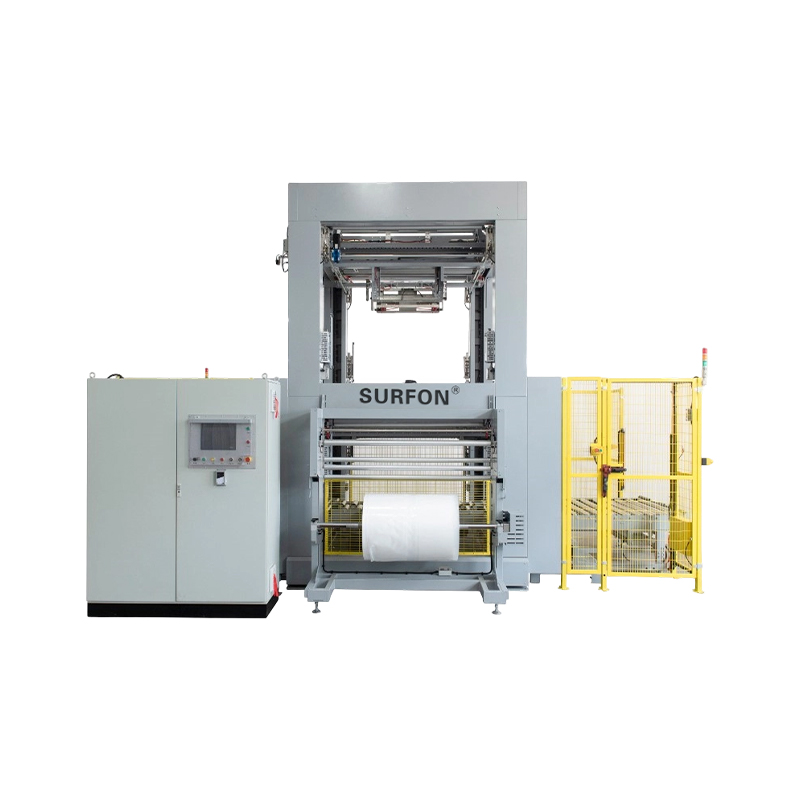 Fully-auto Cold Stretch Hooding Machine SuppliersNew + Fully-auto Vertical Cold Stretch Hooding Machine View More Details Get a QuoteView Product → provides a fully automatic cold stretch hooding process that uses a single hood of film rather than multiple wraps. This method eliminates overlap waste and can reduce film consumption by an additional 15–20% compared to conventional spiral wrapping, especially for uniform loads.
When loads require heat sealing for weather resistance, the  Fully-auto Pallet Shrink Wrapping Machine SuppliersNew + Pallet Shrink Wrapping Machine View More Details Get a QuoteView Product → applies shrink film around the entire pallet, creating a dust-proof, tamper-evident seal. Although shrink wrapping uses slightly more film than cold stretch hooding, it offers superior protection for outdoor storage and long-distance shipping.
For budget-conscious facilities that want to move from hand wrapping to automation, the  Economic Stretch Hooding Machine1. Heatless Cold-Stretch Environmentally Friendly Process: The entire process relies on the physical stretching of the PE film for wrapping and sealing, requiring no h...View Product → delivers a controlled stretch cycle at a lower initial investment. This machine maintains consistent film tension and can handle up to 30 pallets per hour, making it ideal for small to medium-sized warehouses.
Practical Tips to Reduce Stretch Wrap Consumption Per Pallet
- Use powered pre-stretch: Even a simple machine with 200% pre-stretch cuts film use by half compared to hand wrapping.
- Match film gauge to load weight: For loads under 1,500 lbs, 60-gauge film with 250% stretch often provides sufficient strength. Heavier loads may need 80-gauge but with fewer layers.
- Optimize revolutions: Test the minimum number of wraps that still passes a tip-over test. Many operations over-wrap by 30% or more.
- Standardize pallet dimensions: Using consistent pallet sizes allows you to program machine parameters precisely and avoid waste from varying perimeters.
These adjustments, combined with automation, can reduce your per-pallet film usage from the 150–200 ft range down to 40–60 ft. Over a year, the savings on stretch wrap alone often justifies the equipment investment within months.
To learn more about calculating stretch wrap needs for your specific loads, read our detailed guide: How Many Feet of Stretch Wrap Per Pallet (and Which Wrapping Method Is Right for You). For a broader view of how packaging automation applies to various industries, explore e-commerce warehousing applications.
Conclusion: Know Your Numbers, Cut Your Costs
Answering “how much stretch wrap per pallet” is not a fixed number—it’s a calculation that depends on your specific pallet size, wrapping process, and equipment. For a standard 48×40-inch pallet hand-wrapped, you’re looking at roughly 150–200 feet. With a machine wrappers at 250% stretch, that number drops to 45–70 feet. The fastest way to reduce film consumption is to automate and apply controlled stretch. Shanghai KUKO’s cold stretch hooding and pallet shrink machines offer proven solutions that not only save film but also improve load quality and throughput. Measure your current usage, run the numbers, and consider an upgrade—the return is both measurable and immediate.





-
 How Many Feet of Stretch Wrap Per Pallet and Which Machine Is Right for Your Output
 -
Multi-Dimensional Detailed Introduction to Heat Shrink Film Packaging Machines
-
Is Fully Automatic Shrink Wrapping Equipment Right for Your Production Line?
-
Sleeve Sealing Shrink Wrapping Machine: Process, Types & Buying Guide


Copyright @ Shanghai KUKO Packing Machinery Co., Ltd. All rights reserved
