


 中文简体
 Español

 2026.10.27
how many pallets will a roll of shrink wrap: Practical Applications, Selection
Content
- 1 What Determines How Many Pallets a Roll of Shrink Wrap Covers?
- 2 A Simple Way to Estimate Pallets Per Roll
- 3 Hand Wrapping vs. Machine Wrapping: Why the Numbers Diverge
- 4 Shrink Hoods and Shrink Tunnels: A Different Calculation
- 5 Practical Tips to Get More Pallets From Every Roll
- 6 Frequently Asked Questions
Whether you're prepping for a busy shipping week or planning inventory for your warehouse, the question of how many pallets a single roll of shrink wrap can cover seems simple — until you stand in front of an incomplete pallet and realize you're almost out of film. In our two decades of building packing machinery, we've found that the answer almost always depends on a few key variables. Here's what actually moves the number, and how you can calculate it for your own operation.
Before we dive into the math, a quick note on language: the flexible film used to secure palletized loads is often called stretch wrap or pallet wrap, and sometimes shrink wrap. The same principles apply to conventional stretch film rolls, and we'll also touch on heat-shrink hoods where they differ.
What Determines How Many Pallets a Roll of Shrink Wrap Covers?
Several factors can change the coverage number by two or three times. The table below summarizes the most important ones.
| Factor | Effect on Coverage |
|---|---|
| Film roll length | Longer rolls naturally cover more pallets; 1,500 ft hand rolls and 5,000 ft machine rolls are common. |
| Pallet size | Larger footprint and taller load require more film per revolution. |
| Wrapping pattern | More top and bottom revolutions lock the load but consume more film. |
| Stretch rate | Hand wrapping usually reaches 20–50% stretch; powered pre-stretch can exceed 250%. |
| Film gauge and width | Thicker film adds rigidity but reduces usable footage per roll; narrower film may need more passes. |
If you're in a hurry, a common rule of thumb is that a 1,500 ft hand roll covers 8 to 15 standard pallets, while a 5,000 ft machine roll can cover 90 to 120 pallets. But those numbers are only useful as a starting point.
A Simple Way to Estimate Pallets Per Roll
You can estimate coverage with one formula:
Pallets per roll = (roll length × stretch factor) ÷ (film used per pallet)
Here's the process step by step:
- Measure the pallet perimeter. For a standard 48 in × 40 in pallet, that's roughly 176 in (2 × (48+40)).
- Decide how many full wraps the load needs. A stable load may require 3–5 bottom wraps, a few vertical spirals, and 2–3 top wraps. Count the total number of full revolutions.
- Multiply the perimeter by the total revolutions to get base feet per pallet.
- Adjust for stretch. Hand wrapping with 30% stretch gives a stretch factor of 1.3; a machine with 250% pre-stretch gives 3.5.
- Divide the effective film length by the feet per pallet.
Let's run a quick example. A 1,500 ft hand roll, 48×40 in pallet, and 10 complete wraps around the pallet uses about 146 ft of film (176 in × 10 = 1,760 in ≈ 146 ft) before stretch. With no stretch, you get about 10 pallets per roll. With 50% stretch, your effective length becomes 2,250 ft, bringing the count to about 15 pallets.
Hand Wrapping vs. Machine Wrapping: Why the Numbers Diverge
Machine wrapping is where the coverage gap really opens up. A powered pre-stretch carriage can stretch film 250% or more, which means a 5,000 ft machine roll behaves like 12,500+ ft of film. That's why a machine roll can often wrap 90 to 120 pallets, while a hand roll of 1,500 ft might only do 10 to 20 — even with a skilled operator.
For busy distribution centers, automatic wrappers take the guesswork out of coverage. They apply consistent tension, hit the same number of revolutions every time, and reduce film waste caused by overwrapping. At KUKO, our automatic pallet wrapping systems for logistics and warehousing are designed to give you that consistency while keeping film usage per pallet predictable.
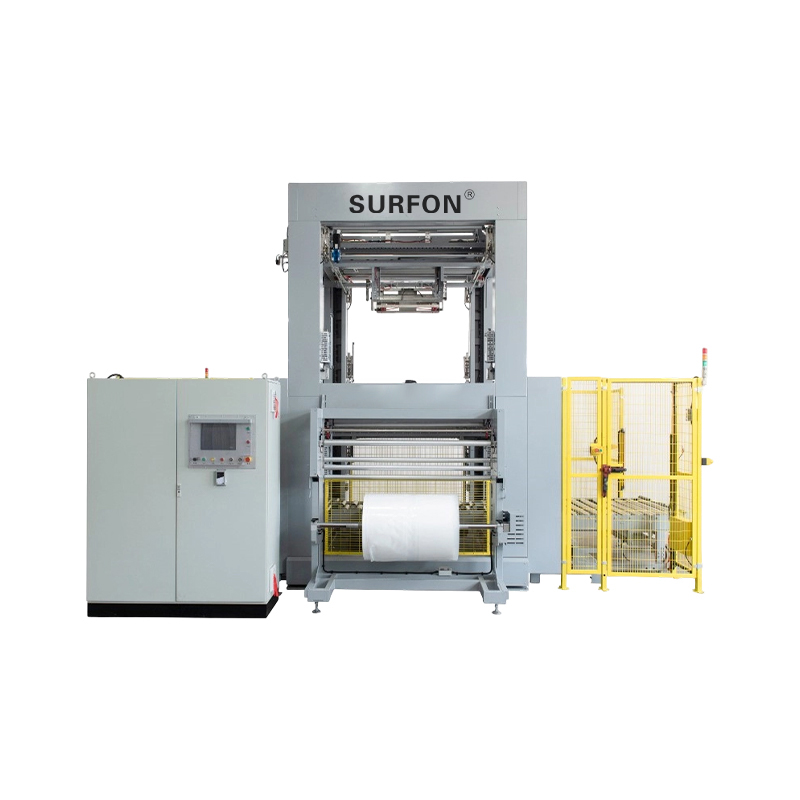 Fully-Auto Cold Stretch Hooding Machines for Consistent Pallet WrappingThis category covers fully automatic cold stretch hooding machines that apply elastic film hoods without heat, ensuring consistent coverage and reduced film waste per pallet.View Product →
If you're currently hand wrapping, it's worth timing a few pallets and measuring how much film you actually use. Most people are surprised to find they're using 30–50% more film than necessary.
Shrink Hoods and Shrink Tunnels: A Different Calculation
Not all pallet packaging uses stretch film. In many beverage, building material and solar panel plants, heat-shrink hoods are placed over the pallet and then passed through a shrink tunnel. A hood is a pre-made bag or tube, so the number of hoods per roll depends on bag dimensions, film thickness, and the shrink tunnel settings — not on stretch ratio.
For example, a flat roll of shrink film could yield 50 to 150 hoods for a standard pallet, depending on whether the bag is sized for a 48×48 in base or a taller, non-standard load.
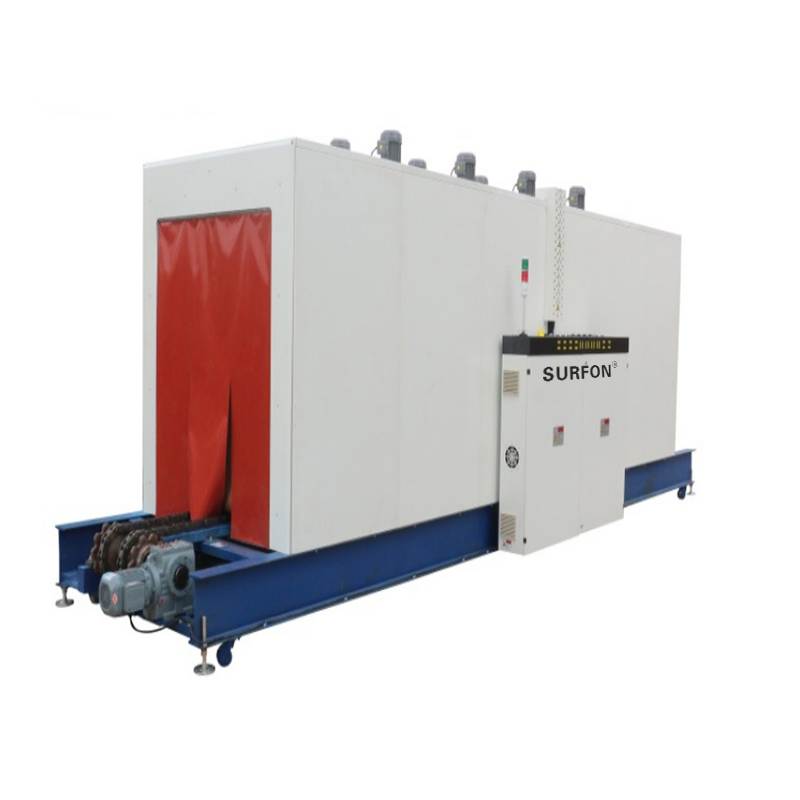 Pallet Shrink Wrapping Machine SF-TP for Heavy-Duty Industrial UseThis machine uses heat shrink wrapping to provide full pallet coverage, with precise shrink cycle control to lower film waste and maintain stable loads in demanding environments.View Product →
If you use both stretch film and shrink hoods in your facility, you'll need to treat them as separate consumables. A machine like a pallet shrink wrapping machine helps control the shrink cycle and ensures the hood is pulled down evenly, which reduces film waste per pallet.
Practical Tips to Get More Pallets From Every Roll
No matter which method you choose, small adjustments can have a big impact on roll yield.
- Use the narrowest film width that still covers the load fully. This reduces overlap waste.
- Choose a film gauge that matches your load weight. Overly heavy film damages easily and is more expensive per pallet.
- Set a consistent wrap pattern with controlled tension. This is easier with automatic equipment.
- Store film in a cool, dry place. Humidity and heat can alter film stretch behavior.
- Train operators to avoid overwrapping corners and edges.
These tips are especially valuable in high-volume environments such as food and beverage packaging operations, where film costs add up quickly across hundreds of pallets per shift.
Frequently Asked Questions
- How much stretch wrap is used per pallet? For a standard 48×40 pallet, typical usage ranges from 150 to 300 ft per pallet, depending on wrap pattern and stretch.
- Can my existing shrink wrap be replaced by a hood? Yes, for full pallet coverage, a heat-shrink hood offers a waterproof, pilfer-resistant outer layer. It will change your per-pallet film cost calculation.
- What is the best way to reduce film cost per pallet? Increase your pre-stretch rate. A 200% pre-stretch can halve your film consumption compared to hand wrapping.
Ultimately, your exact pallet-per-roll number depends on your load shape, the film you choose, and how consistently it is applied. The most reliable way to find it is to measure a few pallets on your own line. For a deeper look at how film length translates into pallet coverage, including which wrap types give you the best yield, see our earlier article on feet of stretch wrap per pallet.



Copyright @ Shanghai KUKO Packing Machinery Co., Ltd. All rights reserved
